Research Article | Volume 4 Issue 4 (2026) | Published in 2026-04-01
Syria and Ukraine in Russian Grand Strategy: Assessing the Limits of Strategic Trade-Offs Across Two Theaters


-
ABSTRACT
This research looks into if Russias actions in Ukraine have forced big shifts in how it handles Syria - or just led to small adjustments without touching its main goals there. Starting in 2015, Moscow stepped in to back Assad, bringing back clout across the region. Yet once fighting intensified in Ukraine after early 2022, pressure built up fast on Russia's military strength, economy, and foreign relations. With these strains in mind, the piece explores whether shifts seen in troop presence, diplomacy, and spending within Syria signal real sacrifice elsewhere - or simply smarter moves under tighter limits.
A fresh look at the data begins by blending numbers with close readings of statements from leaders. Instead, it watches changes over time using both timelines and policy shifts during two stretches - first from 2015 to 2021, then again starting in 2022 until 2025. Through this lens, moves in Syria become clues about larger patterns among strong nations adjusting where they act when pulled in multiple directions. Real power shapes much of what happens, yet ideas and identity play quiet roles too. By following decisions closely, the approach reveals how strategies shift - not just why forces move, but also how meaning gets built around those choices.
War in Ukraine hasnt led Russia to walk away from Syria outright, nor has any clear deal emerged tying Syria to what the West or Israel think about Ukraine. Still, signs show Moscow adjusting how hard it pushes militarily in Syria - less forceful now, yet holding tight to key goals like air bases, sway in the region, and room to maneuver diplomatically. Nowhere is the strain more visible than in how Moscow redirects its efforts mid-conflict. Instead of spreading thinner, it pulls back here to push harder there. Behind the scenes, pressure doesnt force compromise - it triggers recalibration. What looks like retreat often masks reallocation. Choices unfold not through negotiation, yet through silent shifts in weight. Strength bends without breaking, pivoting where least expected.
Keywords: Russia; Syria; Ukraine; strategic trade-offs; tactical recalibration; structural realism; great-power competition.
-
Syria and Ukraine in Russian Grand Strategy: Assessing the Limits of Strategic Trade-Offs Across Two Theaters
. Introduction
When Russian troops arrived in Syria during 2015, the situation changed fast. As government control slipped, support from Moscow held the line - keeping Assad's position intact. Not only did this protect a key partner, yet it also signaled Russias ongoing role in the region. After that point, military operations across Syrian territory became real-world trials: how planes operated, units worked together, gear stood up under fire. Close to shore, they held their ground more firmly each day. What used to shift based on nearby forces began changing under distant pressure - stretching well beyond where Moscow once ruled. Decisions in warrooms thousands of miles away began tilting battles on the ground. Suddenly, influence wasnt just flowing eastward anymore - it curved north too. Through one campaign, positioning changed - not loud, not fast, yet undeniable. Geography gained fresh meaning under this quiet recalibration. Power stretched without declaring victory. Presence deepened while others debated next steps. Now, every shift in the region carries echoes of choices made above Siberian treetops. The balance never snapped - it slid. Yet the weight behind it came clearer after those first airstrikes lit up Syrian nights.
Back in February 2022, when fighting surged in Ukraine, Russia found its global moves suddenly boxed in. That conflict brought heavy loads - on arms money talks abroad - making observers wonder: can Moscow juggle far-flung duties while stretched thin? Under such weight, Syria stood out as a telling example. Would a powerhouse like Russia scale back overseas stakes seen as vital - or reshape them, hold firm - even amid deep strain at home?.
Starting with a puzzle in global politics, this piece explores how big countries shift assets among regions when hit by severe threats somewhere. When survival feels at stake in one place, what happens elsewhere? Take Russia after 2022 - did pulling back in Syria free up energy for fighting in Ukraine? Or were those shifts just minor moves meant to protect larger goals over time, not real sacrifices at all? The core issue lies in telling true cost-balancing from subtle positioning. One change does not mean total overhaul. Shifts might look deep but still leave priorities untouched. So the focus turns to intent behind movement, not only the movement itself.
A closer look at existing work shows plenty on Russia's role in Syria, just as there is ample coverage of its actions in Ukraine - yet little effort connects both under one lens. What tends to slip through isnt facts about either war alone, rather its the shift: did Ukraines burden reshape how Moscow acted in Syria? Not just size or tactics, but what mattered most could have changed. That unexamined pivot remains overlooked.
From the start, it becomes clear that Moscows moves abroad are less about random choices and more about calculated steps rooted in staying strong, handling dangers, first things first, holding ground where it matters most. With this lens, attention turns to Syria - did pulling back happen sharply once fighting began in Ukraine, or did shifts appear only in how support was given, not in its overall shape.
From the outset, this study mixes analysis with close observation of the moments as they unfold. A key section examines changes in military actions and official messages in 2022 and beyond. Remarkable findings link the theory to real numbers. Rather than simply estimating, this creates a method for measuring how impacts change across overlapping emergencies. Real-world details examine whether Russia's favoring of Ukraine over Syria holds up to fact-checking.
A fresh look at the piece shows it avoids retelling political stories or copying news angles. Instead, by comparing ideas through an academic lens, it checks whether a particular strategy holds up under accepted research norms in global politics and security fields.
The Research Significance
The importance of this study stems from its intersection with major transformations in the international system in the international system since the outbreak of the war between Russia and Ukraine in 2022. This was accompanied by a redefinition of the Russian strategic priorities in more than one theater of operations, most notably the Syrian arena connected to the Bashar al-Assad regime.
The significance of this study lies in the following dimensions:
First: The theoretical importance
The study contributes to improving the theoretical discussion on the behaviour of the main powers in managing multiple, simultaneous conflicts. While the structural realism and balance-of-power management literature have addressed the issue of resource allocation, the application of the concept of "geopolitical bargaining" between the actual theaters of operation remains limited. Then, it provides an analytical framework which can be applied to examine similar cases involving various fronts and resource pressures.
Moreover, this study examines the applicability of concepts such as power redistribution, the priority of the immediate threat, and the sustainability of external influence, in the contemporary realistic context, which reinforce the accumulation of knowledge in the field of the strategic studies and international relations.
Second: the practical importance
This study gains practical importance due to its connection with two pivotal issues:- The future of the Russian presence in the Middle East, and the sustainability of its military and political positioning in Syria.
- Russia’s ability to manage a protracted conflict in Ukraine without compromising its gains in other theaters.
Understanding whether there is a strategic withdrawal in Syria or solely a tactical recalibration contributes the policymakers and researchers to assess the trajectory of the Russian policy in the coming stage, while also allowing for a further precise assessment of the regional power balances.
Third: Mythical Significance
One thing distinguishes this study: it ignores the usual media noise and instead focuses on the deeper shifts in military spending, political control, and international relations around the year 2022. Rather than navigating between different moments, it traces events by comparing figures side-by-side. This creates a clear path for the future actions of powerful states dealing with multiple crises under intense pressure.
Fourth: Cognitive Significance
Here is something many studies overlook – the connection between decisions in Syria and those made in Ukraine. Instead of viewing them as two separate stories, this insight links them together. From this perspective, Moscow's global maneuvers begin to appear more interconnected. When viewed collectively, individual moves take on the form of pieces of a larger picture. Beneath what some call isolated actions, a coherent thread extends quietly.
Fifth: Prospective (Future) Significance
The study's findings make it possible to anticipate future scenarios, including:
Russia, now firmly entrenched in Syria, has reduced its spending there. This change frees up resources that are redirected instead to Ukraine. All of this comes at a time when new partnerships are emerging behind the scenes across the region. Such subtle shifts are reshaping the balance, causing concern for many. The significance of this study lies in its closer look at current global tensions, showing how major powers manage competing objectives under pressure – when funding is limited, patience wears thin, and control weakens in times of upheaval.
The research hypotheses
Given the study’s central concern with whether the war in Ukraine generated an implicit strategic trade-off in Russia’s Syrian policy, the article tests the following hypotheses:

The subsidiary hypotheses
Now consider changes in troop numbers together with bombing patterns. Notice where soldiers move across areas, notice supply routes too. Keeping bases active counts heavily, while calm discussions among decision makers hold equal weight. After 2022, leader statements changed - bargaining methods followed close behind. What they said evolved; so did how deals were shaped.
The Research Questions
Since Russia shifted its approach to foreign relations following the start of the war in Ukraine, connections with Assads regime could shift too. That reality opens a few straightforward inquiries, arranged in two parts - a main issue sits alongside narrower points beneath it.
First: the main research question
Now that things changed in 2022, how much has Russia really shifted its focus away from Syria? Could this move reflect a quiet bargain - giving up ground here to hold it there - or just adjusting tactics because fighting takes more than expected?
From the main research question, a number of sub-questions arise, the most important of which are:
1. How can Russias strategic interests in Syria be characterised prior to 2022?.
2. Focusing on Syria, did Moscow act because of urgent battlefield needs - or broader future goals shaping its moves?.
3. How has fighting in Ukraine changed Russias army strength, money situation, its power on world stage?.
4. How much has the conflict tightened material demands elsewhere in Russia's operational reach?.
5. What signs exist - numbers or observations - that show how Russia shifted its approach in Syria after 2022?.
6. What does the idea of a "geopolitical trade-off" really say about how Russia acts in foreign affairs?.
7. Does Russia’s approach follow the rationale of a strategic arrangement or a sequence of prioritised operational decisions?.
8. Does the potential shift in the Russian behaviour toward Syria represent a long-term strategic change, or merely a temporary tactical recalibration?.
9. How might moves in Syria connect to shifts seen in Ukraine when looking at influence across regions?.
Power balances appear shaped by how actions in one area echo through another. Choices made far apart still seem to tilt the wider picture. One conflict mirrors pressures elsewhere, even without clear links. Influence stretches where it is least expected.
The Aim Of The Research
This work looks into how Russias actions in Syria connect to its war in Ukraine, checking if changes after 2022 show a shift in priorities abroad, small adjustments in tactics, or broader shifts in how Moscow handles global engagements. Goals here include studying these patterns without assuming intent, focusing instead on observable moves over time- How can Russia's strategic interests in Syria be portrayed before 2022?.
- Were Russia's interests in Syria driven by immediate strategic concerns or long-term strategic imperatives?.
- How has the conflict in Ukraine affected Russia's military, economic and political capabilities?.
- To what extent has the war created concrete resource pressure in other areas of Russian involvement?.
- Is there quantitative or qualitative evidence of Russia's strategic repositioning in Syria after 2022?.
- How applicable is the term "geopolitical trade-offs" to Russia's political behavior?.
- Does Russia's approach follow a strategic order rationale or a sequence of prioritized operational decisions?.
- Does the potential shift in Russian behavior toward Syria represent a long-term strategic change, or just a temporary strategic recalibration?.
- What does the interaction between the Syrian and Ukrainian theaters reveal about regional and global power dynamics?.
Research Methodology
This work mixes figures with careful analysis to track how Ukraine influenced Russia's steps in Syria. From 2022 onwards, a thread follows the behavior repeatedly; Meanwhile, another considers what these changes might say about broader goals. By juxtaposing events and adding layered meanings, it examines whether changes signal real strategic shifts or merely temporary shifts. Each number offers a guess at the subject – with a clear eye, knowing that things can change again.
Research Design
A look at changes in Russia's actions outside its borders takes shape through contrasting two stretches of time - 2015 to 2021, then 2022 onward. Focus lands on how Moscow moves in both Syria and Ukraine, regions tied together by strategy. To see if events in Ukraine reshaped choices made in Syria, close tracking unfolds step by step. Timing matters here; clues emerge when one shift follows hard upon another.
Data Sources
One way into the work begins with firsthand material - official declarations out of Russia, remarks made by top leaders, papers released by their Defense Ministry, along with a few carefully picked diplomatic records from global bodies. Another layer comes through secondhand analysis: scholarly journals that have undergone review, published studies in book form, sections within academic volumes, plus assessments issued by long-standing think tanks. Materials pulled straight from news outlets appear only when setting the scene, never treated as central proof. The foundation rests elsewhere.
Analytical Strategy
First up, spotting clues about Russias moves in Syria before 2022 - troop presence, air attacks, military posts, talks between leaders, plus what officials said out loud. Once that picture forms, the focus shifts to changes after 2022 hit - which parts held steady, which weakened, which twisted into something new. From there, meaning begins to take hold while using theories such as structural realism, offensive realism, and balance of threat, along with fragments of constructivist ideas to uncover what these trends actually show.
Key Indicators
The study is based on five categories of indicators:
1. Military indicators: troop presence, deployment pattern and operational tempo.
2. Air power indicators: flights, air strikes and changes in intensity.
3. Strategic infrastructure indicators: continuity of access to Hmeimim and Tartus.
4. Diplomatic indicators: official discourse, voting behavior and interaction patterns.
5. Indicator of resource priority: Evidence of redeployment, fiscal pressure and operational substitution in theatres.
Validity and Reliability
A new perspective on government speech, academic studies and the performance of control weaves the three angles into a single snapshot. Using the same instruments across all time periods maintains balance. Shifts or consistencies become visible step by step through clearly defined markers. One view builds on another without losing clarity.
Limitations
Figures on Russian troop positions rarely come into clear light. Online claims sometimes twist reality, colored by bias or the chaos war brings. Inside views of high-level talks in Moscow? Those remain locked away. Clear links between actions and decisions cannot form without them. Missing pieces mean certainty about any formal agreement falls through. Verified findings though do give clues - enough to test how plausible the idea sounds, before guesses take over.
Chapter two
Literature review
One reason the literature review matters? It grounds the research in what's already known, while spotlighting a precise missing piece. Instead of listing past work like separate book reports, this section weaves earlier findings into three linked threads: (1) research focused on Russia's role in Syria. (2) Studies on the RussiaUkraine war and its implications for Russian foreign policy. Looking into how energy gets managed across several regions, plus shifting priorities on a large scale. The way it is set up helps show both existing knowledge and spots where analysis still falls short.
First: Russian Policy and Intervention in Syria
Long seen as more than just battlefield support, Russia's move into Syria ties back to deeper aims like keeping Assad in power. Its return to Middle Eastern affairs plays out through lasting control near the Mediterranean coast. Beyond troop deployments, analysts point to economic motives shaping Moscow's role there. Profits from weapons deals matter, yet so do future gains in oil and gas sectors. Influence grows not only by force, but also through contracts and alliances built slowly over time. Strategic weight expands when ports stay open and supply routes hold firm. Decisions made years ago now shape how far Moscow can reach across regions. Not every goal is loud - some unfold quietly behind trade pacts and infrastructure projects. A different set of analyses focuses on strategy and military reasoning behind the move, suggesting Russia aimed to stop the government from falling while countering Western reach - all at once showing it could act again like a major global player [2]. Across writings from Arab and neighboring scholars, this step marked a shift: Moscow reshaped its position across the region following the uprisings, using Syria as a base for lasting political and armed presence [3]. Even though these studies offer useful insights, their findings often overlap quite heavily. While they generally highlight Syrias strategic role for Russia, differences in how much each values military, economic, or symbolic reasons remain scarce. What stands out more is that many treat Syria in isolation, barely questioning if Moscows stance held steady once its focus shifted sharply toward Ukraine.
Second: The Russia–Ukraine War and Its influence on the Russian foreign policy
Since early 2022, writings about the conflict between Russia and Ukraine have grown fast, looking at its impact on military moves, economies, and diplomacy tied to Russia's outward actions. Because of the fighting, some research explores shifts in how Russia positions itself worldwide while also stirring changes in places like the Middle East [4]. Following 2021, another angle investigates the broader power dynamics guiding Moscows choices, seeing the war not alone but as one piece in a deeper standoff with Western nations, altering long-term planning in profound ways [5]. Though Russia fights in Ukraine, its reach elsewhere shifts too [6]. Work on NATO and European defense shows how much strain Moscow now faces. Nevertheless, these analyzes focus on the West. They drive through areas like the Middle East without stopping long enough to ask real questions. Much of what happens in Syria slips through the cracks. What is rarely noticed is how battles far from home are reshaping Russian elections abroad. Some documents track changes to where Russia is sending troops, weapons or promises. The wider picture remains blurred.
Third: The Analytical and Methodological Gap in the Current Literature
When we look at earlier writings, they divided into three ways. One way sees Moscow's move into Syria as a way to retain power, gain ground nearby and then dig in militarily. Another takes the struggle in Ukraine and looks at it through Moscow's security assumptions, an attempt to reshape the system, as well as a deeper conflict against Western systems. A brief thought touches on how strong nations manage on several fronts when money is scarce. A major problem with current research? It keeps separate what should be connected. Work on Syria tends to see Russias role there as its own isolated story. Meanwhile, analyses of Ukraine zero in on Europe and power struggles, rarely asking how events might affect Moscows moves in the Middle East. So the real missing piece isnt more papers about one country or the other - its a clear way to compare them. Without such a method, it stays unclear if fighting in Ukraine pushed Russia to pull back, shift slightly, or hold steady in Syria.
Fourth: The Contribution of the Present Study
This research tackles the missing link by drawing analytical parallels between Syria and Ukraine under one comparison model. Looking at changes in Russia's military moves, political attitudes and diplomacy around 2022 – using both descriptive insights and measurable signals – makes sense differently. Because of this approach, it adds to existing work on three fronts. An important step: Academic fields are generally kept separate.
Now comes the part where large countries abandon their promises when they are simultaneously pulled in different directions. This setup tests whether the shift in attention between Syria and Ukraine holds up in real life, or what we actually see are small changes that are made immediately. What stands out here is how the work becomes indescribable. Instead of just laying things out, it presents theory—connecting patterns of strategy to ideas about world politics. Through this approach, a new perspective emerges, which suggests ways of comparing actions in different conflict zones. Evidence also plays an important role, looking closely at Russia's moves in Syria after 2022 to see if they indicate a retreat, a change in focus or a steady course despite tensions.
Chapter three
The Theoretical Framework
This chapter aims to establish the theoretical framework upon which the research is based by presenting the theories of the international relations most relevant to this research (especially structural and offensive realism) as well as showing how these theories explain the behaviour of major powers in multi-front conflicts such as those in Syria and Ukraine. Each point is supported by scholarly references in English from the academic sources, with direct links where possible.
Fundamental principles and definitions
The structural realism, or neo-realism, is a main theory in the international relations which explains the behaviour of states in an international system in which there is no central authority, making anarchy the main feature of relations between states [7]. Kenneth Waltz, who is one of the leading theorists of structural realism, states that [8]:- The countries are the principal actors in the international system.
- The international system is anarchic by nature.
- The countries strive to ensure their survival in the face of external threats.
- The power constitutes the central mechanism through which states attain security and safeguard their existence.
Security dictates how great nations behave, showing that survival matters more than belief. What motivates powerful states is necessity, not ideals. A real-life example of this idea occurs when countries spread their power over different areas. Because the global system has built-in boundaries, nations must adjust what is most important based on how serious the threats are in each location – as this research shows.
Second: Offensive Realism
Offensive realism, a branch of structural realism, was put forward by John Mearsheimer in his book "The Tragedy of Great Power Politics," emphasizing the following:
• States seek not only to survive but also to maximize their power.
• The anarchic international system drives great powers to increase their military capabilities to impose hegemony.
• International relations revolve around acquiring power, not merely defending it.
According to this theory, when opportunities arise, great powers seek to expand their influence, thereby increasing the likelihood of conflict.
Third: Classical Realism
Classical Realism and its Foundations
The pursuit of power lies at the heart of realist thought and is closely linked to human behavior. Since leaders act according to their instincts, their decisions shape states as much as global structures do. Although systems impose constraints, internal motivations drive decisions in unexpected directions. Human inclinations merge with the international system, offering a more complete picture than structure alone.
Within the framework of this research, classical realism contributes to understanding the following [10]:
• Why does Russia seek to enhance its influence?
• How can the motivations behind Russian behavior be characterized by combining structural logic with expectations of leadership behavior?
This framework has been used to explain Russian decision-making in Syria and Ukraine from a perspective based on power and interest.
Fourth: Complementary Theoretical Perspectives
Constructivist Theory
How do states operate, and what form do they take? It is not merely about military power, but also beliefs, values, and how states perceive themselves. This idea posits that ideas can be more important than material power [11]. Alexander Wendt, a prominent theorist in this tradition, explains that world politics is not based solely on domination; rather, meanings are shaped through shared ideas constructed via interaction between governments.
When identity changes, power changes. Imagine how Russia's perceptions of its past, its sense of self, and its future aspirations help explain its moves in Syria or Ukraine. What we see are groups acting according to what they believe themselves to be, driven by deep memory, undertaking actions that transcend borders. These moments reflect not just strategies, but ingrained images of place and power. Foreign decisions often echo old internal narratives, linking internal confidence with external presence.
Fifth: Balance of Threat Theory
It is not power alone that shapes state behavior, but also the perceived threat. What drives states is not raw power so much as the feeling of danger. When a state feels targeted, alliances shift. Leaders do not focus solely on size or influence; they look at intentions, geography, capabilities, and recent behavior.
Security is achieved by adapting to new threats rather than waiting for conflict to erupt. This idea reframes traditional perceptions of global stability, as states prepare not because an actor is powerful, but because it appears dangerous.
In Russia's case, reactions are shaped more by perceived threat than by mere confrontations. In Ukraine, where the Western presence is growing, and in Syria, where Western forces remain, these moves carry connotations of danger, not just conflicts. The feeling of being encircled makes reactions more complex, as threats influence decisions more than the facts of direct combat.
Sixth: Integrating Theories into a Unified Analytical Framework
Testing the research hypothesis concerning the geopolitical trade-off between the Syrian and Ukrainian theaters cannot be achieved by relying on a single theory alone, but rather requires:- Structural realism to explain state behavior in an anarchic international system.
- Offensive realism to clarify the great powers' pursuit of expanding their influence.
- Constructivist theory to understand non-material dimensions (identity, international perceptions).
- Balance of threat theory to measure security responses and alliances.
This theoretical integration allows for explaining the following:- To what extent has Russia's involvement in Syria changed in the context of the conflict in Ukraine?
- The rearrangement of strategic priorities.
- The management of resources and risks in line with Russia's overall interests.
Summary of the Theoretical Framework
In other words, this study is based primarily on structural realism and offensive realism, while drawing on ideas from constructivism and balance of threat theory to understand how Russia adjusts its positions without abandoning its core goals. This blend allows for balancing stable patterns with the shifts Russia undertakes, especially as evident in its maneuvers in Syria and Ukraine.
Chapter four
Research Methodology
The chapter introduction
The methodology aims to clarify the research design, data collection tools, analysis methods, and scientific credibility criteria.
This chapter outlines the procedures used to test research hypotheses related to Russia's behavior toward Syria and Ukraine and links them to a theoretical framework based on structural and offensive realism and the balance of threats.
First: the data source
Various sources were used to ensure the comprehensiveness and accuracy of the research:
(Primary Sources):- The official speeches of Russian leaders (Putin, Lavrov, Shoigu).
- The official military reports about Syria or Ukraine.
- The international diplomatic documentrs (The United Nation and Security Council).
The Secondary sources
Second: The data collection tools- Analysing the documents
- Examining the content
Third: The analysis methods
The comparative analysis- A comparative analysis of the indicators of Russian military and political engagement before and after the outbreak of the war in Ukraine.
- Identifying indicators of change to determine the relationship between pressures generated by the war in Ukraine and tactical recalibrations in Syria.
The descriptive statistical analysis
Using timetables, numerical indicators, and ratios to explain the extent of military and diplomatic engagement.
Connecting the data with the theory
Linking the results to the concepts of structural and offensive realism, threat balance and constructivism, to scientifically illustrate the Russian behaviour.
Fourth: Design the studyThe analytic unit The Russian country within the Context of the Syrian and Ukrainian Conflicts The time period It covers the Russian military intervention in Syria and the war in Ukraine from 2015-2025. The comparison Analysis of Russian engagement before and after 2022 to measure the impact of war on strategic priorities The analysis level The strategic, political, and military aspects, integrating qualitative and quantitative data.
Looking at these signs, one thing becomes clear – Russia has not completely left Syria, but neither has everything remained the same. Instead, its presence is now quieter on the ground, but firmly rooted where it matters most: on the ground and in negotiations. What we see fits better into adjusting the movements during the conflict than any grand agreement that was made behind closed doors. Moving back here doesn't mean moving from there – just shifting the weight without losing grip.
Fifth: The standards of credibility and reliability
Results point to a split picture when looking at how Russia acts. Though fighting in Ukraine clearly strained military and financial capacity, affecting activity levels in places like Syria, key commitments did not fade. Even under strain, core positions stayed intact. Diplomatic efforts kept moving forward. Attention to Syrian affairs remained steady despite shifts elsewhere. There is no clear sign of an official exchange between fronts. What shows up instead is a shift in focus - adjusting where effort lands without giving ground on lasting goals in Syria.
Sixth: the summary of the chapter
A blend of ways shaped this study, using numbers alongside personal insights to build understanding. Different angles came together - some counting facts, others exploring thoughts - to form a fuller picture through combined techniques. From libraries to field reports, it checked each piece against others. Different origins helped confirm both depth and correctness. Truth stood clearer when details matched across tests. Starting off, researchers looked through documents to gather information. Then came a close review of written material, digging into meanings behind the words. After that, findings were tied back to key ideas already known in the field. A fresh approach shaped the study, aiming to check its core ideas with care while tying outcomes to how Russia acted in Syria along with Ukraine. One path led through detailed analysis, another through real events - each choice built on what happened where decisions mattered most. Scientists must meet strict quality checks so their work can appear in trusted research databases. What counts is clear proof, solid methods, and strong results. Only then does a study stand a chance of being accepted. Careful analysis matters more than bold claims. Journals look closely at how data was gathered, whether steps were repeated correctly. Mistakes weaken trust fast. Truth comes from consistency across trials. Published findings need to hold up under pressure. Reproducibility builds long-term confidence.
Chapter five
The Scope of Russian Military Involvement in Syria
(2011–2025)
This chapter presents a detailed examination of the nature and magnitude of Russia’s military intervention in Syria from the onset of the crisis in 2011 to 2025 with quantitative and qualitative data on forces, equipment, weapons, and targets. It relied on the published scientific studies and reliable reports.
First: The Temporal Background of the intervention’s start
The Russian intervention in Syria, which began in 2015, was initially considered a decisive step aimed at stabilizing the Assad regime and challenging Western influence in the Middle East. The Russian military campaign – which was characterized by intense airstrikes, Special Forces operations and diplomatic cover at the UN – succeeded in halting the opposition's advance while allowing Assad to retain his grip on power for nearly a decade. Yet when the government fell in 2024, everything changed – Russia's role suddenly became much heavier than before, making what had started as a modest notion much harder to walk away from. Fifteen years after unrest began in Syria, Russia stepped in with force - air strikes rolled out under Moscows orders only by late 2015, aimed at keeping Assad in power [15]. Before then, Russia backed the Syrian military mainly through instruction and weapons delivery - also sending guidance experts - though staying clear of setting up flight hubs or launching attacks on armed groups [16].
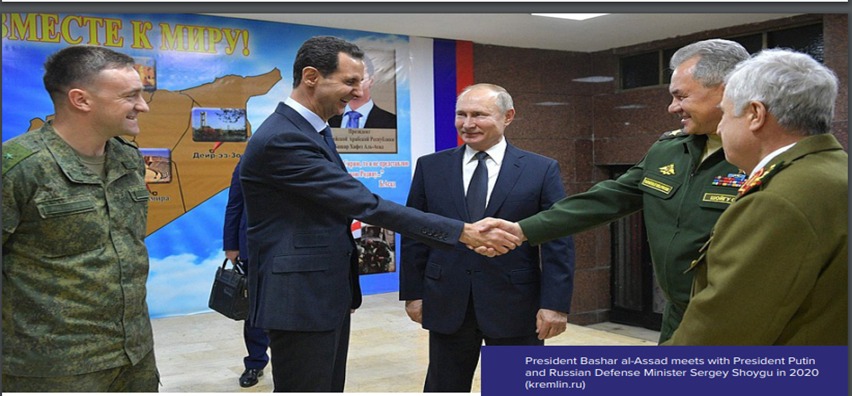
Source: https://www.fpri.org/wp-content/uploads/2020/09/syria-and-the-russian-armed-forces-kofman.pdf?utm
The essential timetableSeptember 2015 The beginning of the air intervention [17]. 2016-2018 The peak of Russian air operations and engagement the activities in ground [18]. 2019-2021 A relative decrease in operations, yet a continued military presence [19]. 2022-2025 The influence of the war in Ukraine on troop presence and adjustments to engagement priorities.
Second: The deployed forces and their numbers
The Russian regular forces
The research estimates indicate that Russia did not disseminate its forces with a huge force compared to conventional wars, yet rather depended on a force concentrated in specific locations.
According to analytical estimates, the direct Russian ground contingent in Syria was roughly 3,000 regular soldiers, alongside about 2,000 contractors associated with private military companies during specific periods [20].
These numbers remain relatively minor compared to the traditional engagement. However, they are sufficient to control the strategic points and coordinate with the Syrian army [21].
Timetable 1: The Estimated number of Russian troops in SyriaThe category The estimated number The regular armed forces 3,000 The members of private military companies ~2,000 The total Russian power at peak times 5,000
Note: these numbers are estimates based on the analytical studies and are not formal open Russian data [22].
Third: The physical distribution of the military equipment
Aircraft and Air Force
At the beginning of its intervention, Russia deployed a wide fleet of aircraft at the Hmeimim Airbase, including [23]:
Fighters, bombers and attack aircraft of various types such as Su 24, Su 25, Su 34 and Su 30.
According to open records, Russia had disseminated around 50 aircraft at the Hmeimim base at the end of 2015.
Furthermore, Russia utilised attack helicopters and unmanned reconnaissance drones to provide operational support and logistical assistance [24].
The air defense support and ground equipment
The Russian presence was enhanced with the air defense systems such as the SA‑22 Pantsir to protect aerial assets in the region, in addition to armored vehicles and missile systems [25].
Fourth: The weapons used and combat operations
Russia's air campaign
According to the open records and the military analysis:
During the two-year Syrian campaign which lasted from September 2015 to January 2018, the Russian military air forces—involving the fleet aircraft (excluding helicopters, transport, and reconnaissance planes)—conducted over 34,000 combat sorties in Syria, averaging 42 sorties per day (see timetable 2). During the peak operational periods, daily sorties exceeded 100, though the average remained between 70 and 80 combat missions per day, corresponding to two to three sorties per aircraft, or three to four sorties per active plane [26].
Table 2. Total number of sortiesDate Sorties Average per day Targets hit 03.10.2015 60 15 50 22.10.2015 934 41 819 29.10.2015 1391 46 1623 16.11.2015 2289 48 4111 14.12.2015 4201 55 n/a 24.12.2015 5240 61 n/a 22.02.2016 11700 80 22000 22.12.2016 18800 42 71000 26.04.2017 23000 40 77000 25.08.2017 28000 40 90000 22.09.2017 30650 42 96828 22.12.2017 34000 42 n/a
Source: Anton Lavrov, The Russian Air Campaign in Syria: A Preliminary Analysis, Centre for Analysis of Strategies and Technologies, June 2018, https://apps.dtic.mil/sti/pdfs/AD1057649.pdf
Chart 1: The evolution of the number of Russian air strikes 2015-2017
(Regarding the air campaign which was nearing 70,000 hit during the peak RAND based on the data) [70].
Year | Strikes
2015 | 10,000+
2016 | 30,000+
2017 | 31,000+
(These figures are approximate as they show the large scale of the first air campaign)
FIGURE 3.3 Russian Airstrikes in Syria: September 30–October 30, 2015
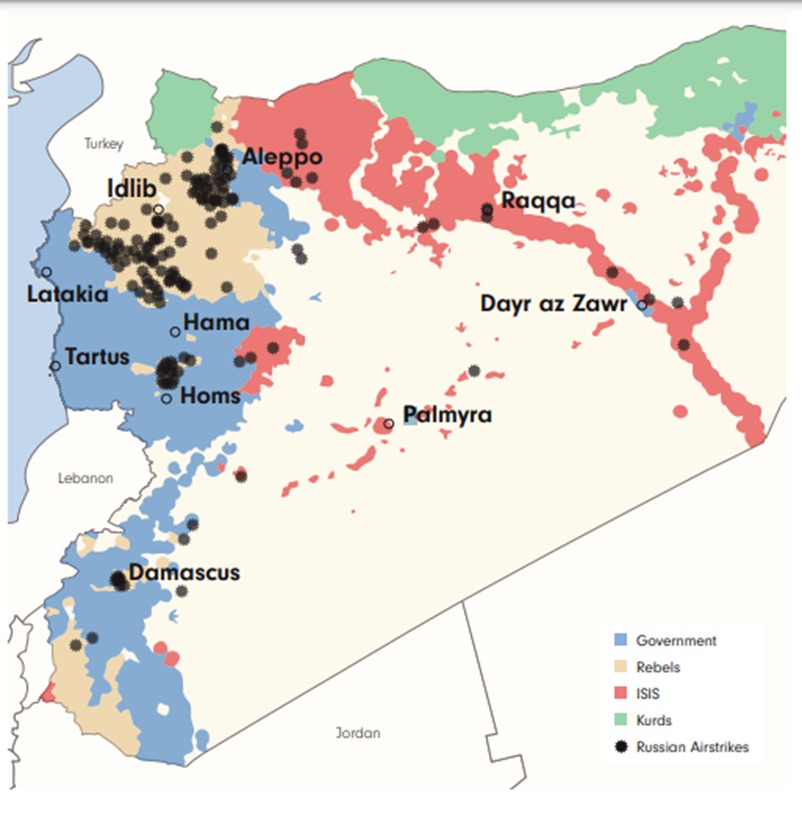
Source: Genevieve Casagrande, “Russian Airstrikes in Syria, September 30, 2015 to September 19, 2016,” Institute for the Study of War, October 2016, http://www.understandingwar.org/sites/default/files/ Russian%20Airstrikes%20Maps%20SEPT%20 2015-SEPT%202016.pdf
The ground operations and the ground support
While the air campaign constituted the most prominent factor of the intervention, Russia also offered limited physical support to ground forces through the followings [28]:- The unite of engineering support
- consultants and experts
- Coordinating operations with the Syrian army
- Continuous logistical support for weapons and equipment such as tanks and armored vehicles.
Fifth: The strategy and sites
1. The Russian military bases in Syria
The most prominent bases where Russia has maintained a permanent military presence:
Hmeimim Air Base: The main air center for air operations.
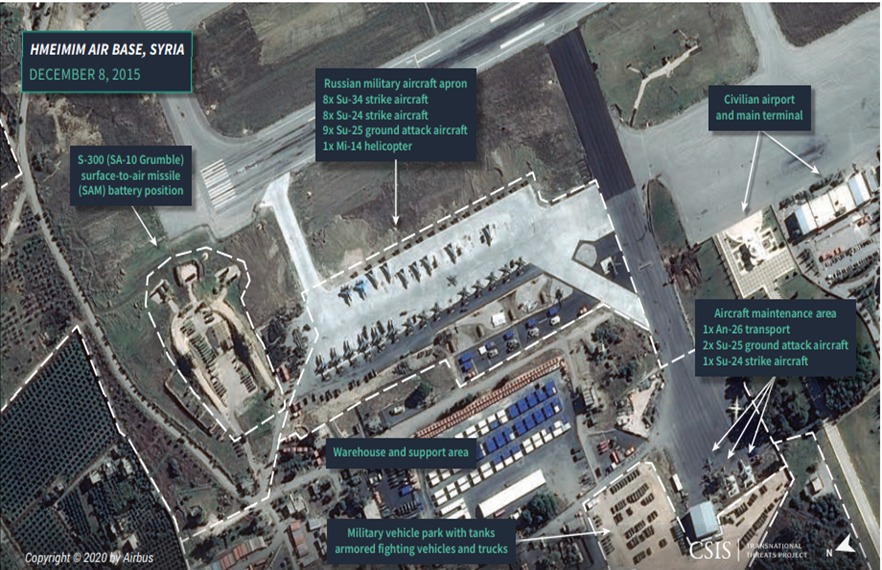
Source: https://csis-website-prod.s3.amazonaws.com/s3fs-public/publication/Jones_MoscowsWarinSyria_WEB_update.pdf?utm
Tartus Naval Base: Russia's only strategic port in the Mediterranean.
FIGURE 2.3.1 Satellite Imagery of Tartus, September 2015
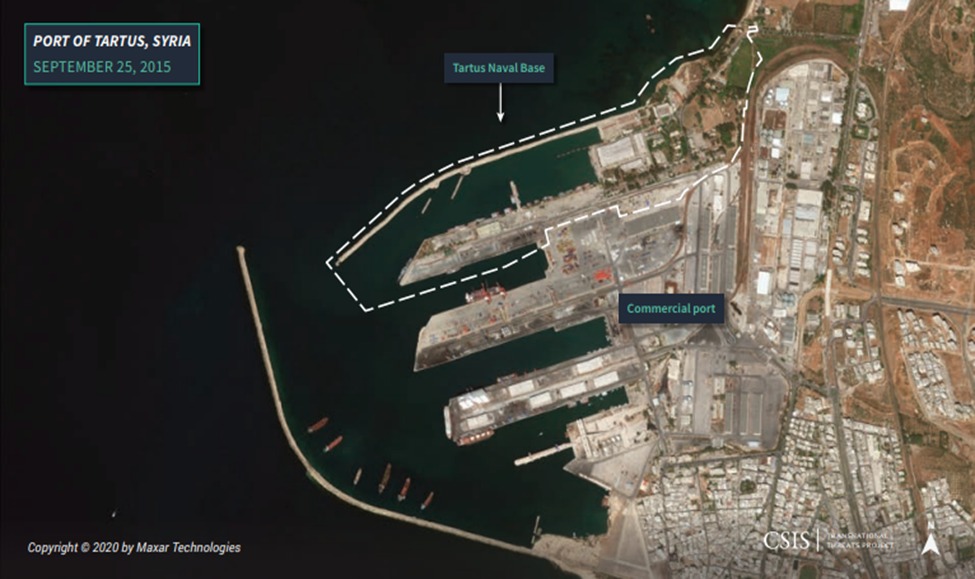
Source: https://csis-website-prod.s3.amazonaws.com/s3fs-public/publication/Jones_MoscowsWarinSyria_WEB_update.pdf?utm
In addition to smaller deployment points in some areas such as Homs, Damascus and southern Syria to support logistical capabilities.
These bases constitute the most significant strongholds of Russia in Syria and maintain projection capabilities (military reach beyond Syria) over the Mediterranean and Western Europe.
Sixth: The Human cost and the military losses
According to the open data, the formal numbers among Russian forces are merely partially known:- By the end of 2024, the total number of Russian regular forces killed reached roughly 190, alongside 7 officers from Russian security bodies.
- Moreover, there are various estimates showing that hundreds of personnel from the private military companies (such as Wagner) were killed during the fighting in Syria over the years of intervention.
Table 1. RuAF aircraft losses in SyriaDate Type No. of crew and passengers dead Region Circumstances 24.11.2015 Su-24M 2 Latakia Downed by Turkish F-16 24.11.2015 Mi-8AMTSh 1 Latakia Destroyed on ground by TOW ATGM 12.04.2016 Mi-28N 2 Homs Crashed during night flight 14.05.2016 Mi-24/35M 0 T4 air base Burned on ground after mortar attack 14.05.2016 Mi-24/35M 0 T4 air base Burned on ground after mortar attack 14.05.2016 Mi-24/35M 0 T4 air base Burned on ground after mortar attack 14.05.2016 Mi-24/35M 0 T4 air base Burned on ground after mortar attack 09.07.2016 Mi-35M 2 Palmyra Hit by ATGM in the air 01.08.2016 Mi-8AMTSh 5 Idlib Hit from the ground 03.11.2016 Mi-35M 0 Palmyra Forced landing, destroyed with ATGM on ground 13.11.2016 MiG-29KUB 0 Sea Accident during landing on aircraft carrier 03.12.2016 Su-33 0 Sea Accident during landing on aircraft carrier 06.10.2016 Mi-28N 0 Hama Forced landing 10.10.2017 Su-24M 2 Khmeimim Accident during take off 31.12.2017 Mi-35M 2 Hama Forced landing 03.02.2018 Su-25SM 1 Idlib Shot down by MANPAD 06.03.2018 An-31 39 Khmeimim Accident during landing 03.05.2018 Su-30SM 2 Khmeimim Accident during takeoff 07.05.2018 Ka-52 2 Euphrates Shot down
Source: Anton Lavrov, The Russian Air Campaign in Syria: A Preliminary Analysis, Centre for Analysis of Strategies and Technologies, June 2018, https://apps.dtic.mil/sti/pdfs/AD1057649.pdf
Seventh: The evolving of the spread size until 2025
The intervention from 2015 to 2025 cannot be measured by both the actual numbers on the ground and its strategic influence and long duration of presence:
Following 2022, Moscow adjusted the distribution of its forces as a result of the Russia–Ukraine war. It also reduces certain aspects of its direct military engagement in Syria while prioritising maritime security, air defense, and the upkeep of its principal bases.
By 2026, reports suggested a partial withdrawal of Russian forces from Qamishli Airport in northern Syria with an aim to reduce the commitments in inland areas and concentrating on the coastal sites [29].
Eighth: The Strategic objectives of this presence
According to the academic studies, the intervention was not merely a temporary military presence, but had profound strategic objectives as follows:- Supporting the Assad regime and preventing it from collapsing [30].
- Establishing Russia's impact in the Middle East and the Mediterranean [31].
- Improving Russia's ability to use naval and air bases outside Russia itself.
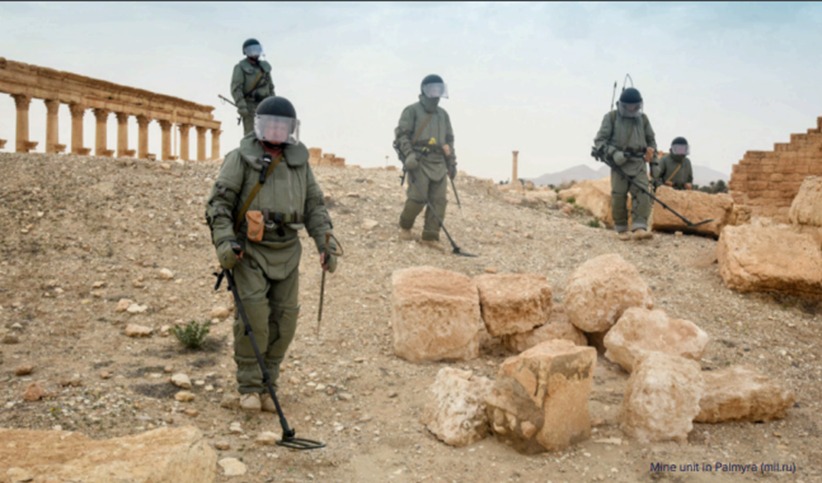
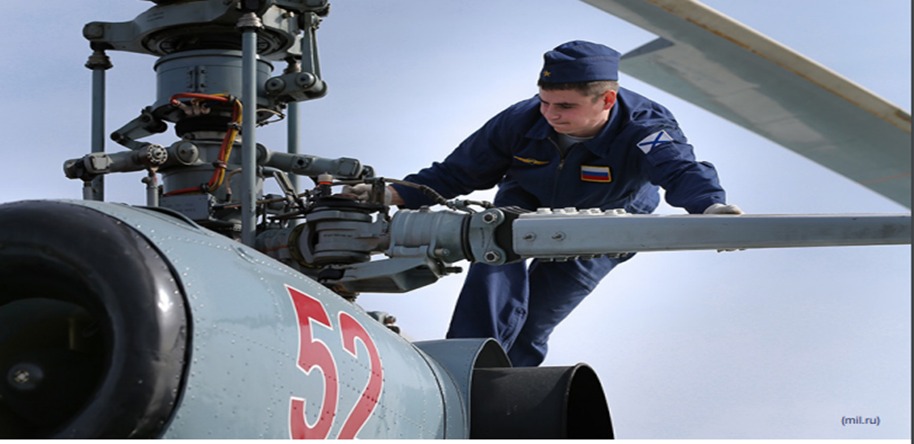
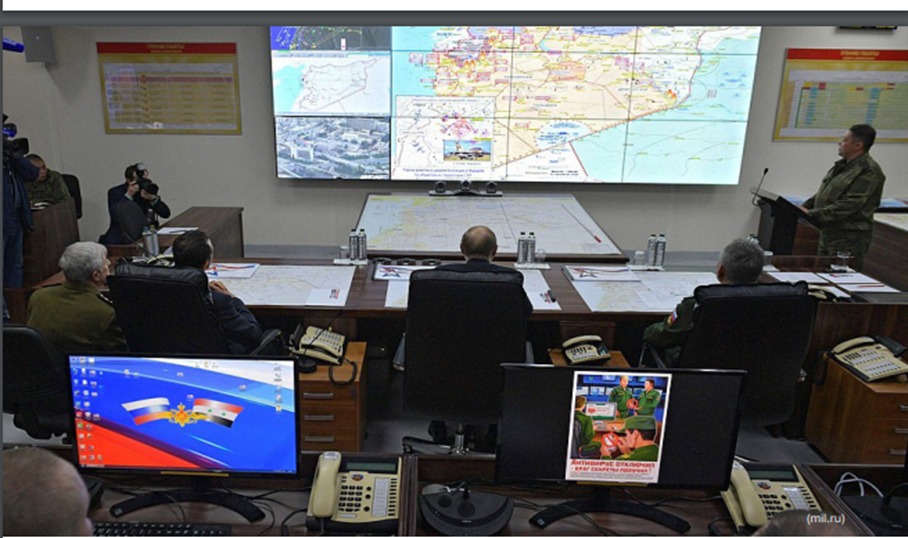
https://www.fpri.org/wp-content/uploads/2020/09/syria-and-the-russian-armed-forces-kofman.pdf?utm
The summary
Between the years 2011 and 2025, the Russian military intervention in Syria evolved from the political logistical support to physical commitments and heavy weapons, and then to a long-term strategic presence. This presence depends on various levels of forces, advanced air equipment, and complex defense systems distributed in the strategic locations such as Hmeimim and Tartous. Although the numbers of Russian forces were not huge (only a few thousand), the quality and defensive tactics made them a very influential force in the progress of the Syrian war [32].
The political and diplomatic support
This is explained by the use of the veto power, as shown in the following table:
Table (4) Russian UNSC Vetoes, 2011 to 2019Date Resolution Overview October 4, 2011 S/2011/612 Russia used its veto power (veto) against a draft of the United Nations resolution condemning gross human rights violations in Syria and threatening the Syrian government led by President Bashar al-Assad with taking action against it.
February 4, 2012 S/2012/77 Russia used its veto power against a draft resolution condemning the Syrian government's crackdown on the opposition.
July 19, 2012 S/2012/538 Russia exercised its veto power against a Western-backed resolution threatening Syria with sanctions if it failed to cease the use of heavy weapons.
May 22, 2014 S/2014/348 Russia used its veto power against a French-drafted proposal in the UN Security Council to refer crimes committed in Syria to the International Criminal Court (ICC).
October 8, 2016 S/2016/846 Russia used its veto against a text proposed by France and Spain to halt the bombing of Aleppo, after Russia submitted a rival draft resolution calling for a ceasefire without including any text prohibiting military flights over the city. December 5, 2016 S/2016/1026 Russia used its veto power against a resolution calling for a ceasefire in the city of Aleppo. February 28, 2017 S/2017/172 Russia used its veto power (veto) against a resolution drafted by Britain, France and the United States to impose sanctions on Syria over the use of the chemical weapons in the conflict. April 12, 2017 S/2017/315 Russia used its veto power (veto) against the draft resolution demanding that the government of President Bashar al-Assad cooperate with the investigation into the deadly chemical attack that occurred in the opposition-controlled town of Khan Shaykhun in April. October 24, 2017 S/2017/884 Russia used its veto against a resolution aimed at expanding the mandate of the joint United Nations-Organization for the Prohibition of Chemical Weapons (OPCW-UN JIM) tasked with identifying those responsible for chemical weapons attacks in Syria, for an additional year before its mandate expires on November 17. November 16, 2017 S/2017/962 The mandate of the Joint United Nations and Organization for the Prohibition of Chemical Weapons (OPCW-UN JIM) team ended after both resolutions submitted to the UN Security Council to extend it failed. The US-sponsored resolution received 11 votes in favor, 2 against, and 2 abstentions, and failed due to Russia's use of its veto power (veto). The Russian decision received 4 votes in favor, 7 against, and 4 abstentions.
November 17, 2017 S/2017/970 Russia used its veto power (veto) against a UN Security Council resolution submitted by Japan to expand the mandate of the UN-Organization for the Prohibition of Chemical Weapons Joint Team (JIM) for 30 days. April 10, 2018 S/2018/321 Russia exercised its veto against a United States–sponsored resolution that would have established an independent United Nations investigative mechanism for one year to identify those responsible for the use of chemical weapons in Syria.
September 19, 2019 S/2019/756 Russia used its veto against a request for a truce in northwest Syria because it did not involve an exception for military operations against armed groups blacklisted by the United Nations.
December 20, 2019 S/2019/961 Russia used its veto against a resolution that would have allowed humanitarian aid to be delivered across borders from two locations in Türkiye and one location in Iraq to Syria for 12 months.
SOURCE "Security Council – Quick Links," United Nations Security Council, http://research.un.org/en/docs/sc/quick/meetings/
Chapter six
The Applied Analysis: The Russian policy in Syria and Ukraine
(2015–2025)
Introduction
This chapter aims to analyses the data and political and military developments in the Syrian and Ukrainian arenas using methodological tools such as process tracking and comparative indicators before and after 2022. These were used to test the main research hypotheses. The analysis depends on various sources: the military data, official Russian political discourse, peer-reviewed academic studies, and reports from accredited research centers.
First: Russia in Syria before the Ukrainian war 2015-2021- The nature of military and political engagement
Since September 2015, Russia has started a direct military intervention in Syria with an aim of supporting the regime of Bashar al-Assad and preserving its strategic foothold in the eastern Mediterranean. This intervention was both military (through the deployment of troops and aircraft) and political (through diplomatic conferences such as Astana and Sochi) [33].
The main points:- Russia has maintained the Hmeimim and Tartus bases as centers of military influence on the Mediterranean.
- Russia entered the conflict to support a strategic ally, not only under the guise of fighting terrorism.
- At that time, Russia was not in direct confrontation with major international powers as is the case in Ukraine.
The balances and interests of Russia
According to the researches, the strategic objective of Russia's continued presence in Syria was [34]:- Securing a permanent military foothold.
- Protecting the political partner against the potentially unfavorable alternatives.
- Enhancing the negotiations with the West on other issues
Second: The Russian-Ukrainian war and its influence on Moscow's priorities
(2022-2025)- Changing of the pressure level on the Russian resources
At the outbreak of the war in Ukraine in 2022, Russia’s military and economic capabilities came under immense pressure due to [35]:- Depletion of the military resources
- Unprecedented the economic sanctions
- Redirecting diplomacy and the political efforts
Conclusions:
Following 2022, the war in Ukraine became the primary theater of the Russian resulting in a recalibration focus, of its foreign policy priorities.
Russia was compelled to redirect the resources away from some of its external operations in order to address what it perceives as an existential threat.
Third: Comparing the level of Russian engagement in Syria before and after 2022- The military indicators
The following indicators can be compared before and after 2022: [36-37]Indicators Before 2022 After 2022 Number of Russian troops deployment
High and stable Relative decline in the presence of heavy combat units The role of the rules (Hmeimim/Tartus) pivotal Remaining, yet in a less involved context airstrikes Intense Relatively mild or less noticeable
It should be noted that the declining indicators do not imply a complete withdrawal, but rather a tactical adjustment.- The political and diplomatic indicators
After 2022[38]:
Russia continues to provide diplomatic support to Syria in international forums. However, its intensive military presence has decreased. After 2024, Moscow is also focused on strengthening its ties with new local actors in Syria, including opposition forces seeking to topple the regime.
Fourth: Analysis of formal Russian Discourse
During the analysis of the statements of Russian leaders (Putin, Lavrov and Shoigu), it can be seen that [39]:
Prior to 2022, Russian discourse emphasized protecting the Syrian regime and maintaining stability in Syria. After 2022, however, the focus shifted to prioritizing security considerations in Ukraine, while pursuing a less prominent and more limited political engagement in Syria.
Fifth: Examining the research hypotheses
Hypothesis of no direct trade-off which is based on the followings:
Russia has not formally left Syria, nor has it announced any explicit agreement. This suggests that direct, declared retaliation can be rejected.
Hypothesis of declining military commitment
The data indicated that:
Concentration of resources on Ukraine as well as a partial reduction in involvement. This can be considered an indicator of reprioritization, but it is not an obvious contradiction.
Sixth: Discuss the results
The analysis connects the theoretical framework (structural and offensive realism and threat balance) with practical results:
Russia faced an existential threat in Ukraine, forcing it to reallocate its resources. This adjustment was a tactical rather than a strategic retreat. Furthermore, its structural interests in Syria were not abandoned, but rather reorganized in the wake of the war in Ukraine.
Chapter Seven
Assad’s Syria in exchange for Ukraine
Was there an agreement between Russia and both the United States and Israel for a Russian withdrawal from Syria and the removal of Assad, in exchange for U.S. and Israeli non-intervention in the war in Ukraine?- Until the date, the political studies and research institutions have not confirmed the existence of a formal deal or direct negotiated agreement connecting a Russian withdrawal from Syria to a cessation of U.S. or Israeli involvement in Ukraine—neither via governmental documents nor via verified official statements.
The literature reported that the relations between Russia and Western powers in Syria and Ukraine are conducted throughout separate and contradictory negotiations rather than being just a “single deal” [40].- The strategies of Russia in Syria is tied to its wider geopolitical objectives rather than being exclusively driven by the war in Ukraine
The academics view Russia’s intervention in Syria as a result of Moscow’s historical and strategic impact in the Middle East to safeguard its military and political interests, rather than as a reaction to the war in Ukraine [41].
This approach is analyzed within the framework of Russian foreign policy by linking Syria's aims to concepts of the international influence, and not as a method of direct exchange with other files such as Ukraine.- The relationships between Russia and The United States in Syria witnessed phased coordination without any “comprehensive deal”.
Despite the fact that there has been a limited coordination between the United States and Russia regarding a temporary cessation of bloodshed or negotiating a ceasefire in Syria, there are no formal documents proving the existence of a comprehensive agreement linking Syria to Ukraine[42].
In March 2025, Russia announced that it was cooperation with the United States on the Syrian conflict in the context of de-escalation. However, this coordination did not equal a comprehensive deal.- Discussion of deals linking the Syrian and Ukrainian files is widespread in the media but is not academically proven.
The idea of an “influence swap” between Syria and Ukraine repeats in the media analyses and monitoring reports. Nevertheless, there is no concrete evidence in the academic studies or formal documents to substantiate it [43].
Analysts have argued the possibility of the arrangements between major powers, but there is no documented evidence that they are realistic or official.- The relationship between Russia and Israel in Syria is concentrated on the regional security and not a bilateral deal on Ukraine
The relationship between Russia and Israel has primarily focused on the security concerns related to the Iranian presence in Syria and cooperation over Israeli strikes against Iranian targets, rather than on exchanging the Ukraine issue for a Russian withdrawal [44].
Analytical reports demonstraed a tactical reconciliation between Moscow and Jerusalem on some military issues, but do not agree with the Ukraine-Syria file.- The fall of the Assad regime in 2024 reformed the Syrian issue, but it did not result from a “Russian-American deal.”
According to reports, various roles in Syria were discussed in the event of Assad’s fall. However, there are no formal arrangements connecting these roles to a “cessation of support in Ukraine.” The fall of Assad would have led to strategic adjustments for Russia in the Middle East. Nevertheless, it does not imply an exchange of influence with the United States in Ukraine [45].- Russia strives to maintain its military presence in Syria after Assad which is a goal independent of Ukraine
Institutional analyses show that Russia leverages its military presence in Syria as an instrument of long-term strategic influence, rather than as a bargaining chip tied to the war in Europe [46].
These projects are related to protecting Russian interests in the Middle East and not a deal with the West over Ukraine [47].- The US-Russian negotiations on a ceasefire in Ukraine were not connected to Russia's withdrawal from Syria
Even in broad negotiation frameworks, such as the Riyadh 2025 meetings, there are no formal discussions connected a withdrawal from Syria to conditions for a ceasefire in Ukraine.
The peace discussions concentrated on ceasefire operations and diplomacy, without establishing any “file exchanges” [48].- There is no evidence that Israel made concessions regarding Ukraine in exchange for Russia's withdrawal from Syria.
The Israel-Russia relationship in the context of Syria is mainly centered on shared regional security issues, such as the Golan Heights and Iranian activities, rather than on exchanging matters related to the war in Ukraine [49]. In this regard, Moscow’s ties with Jerusalem in Syria follow an independent strategic security logic, separate from the Russian-Ukrainian conflict [50].- The academic overview: there is no comprehensive mutual agreement between the main powers that brings together Syria and Ukraine
The summary of studies addressing the international relations in the Syrian and Ukrainian contexts asserts that each case follows the logic of its own alliances and interests. To date, there is no indication of any internationally recognised, public, or institutional agreement connecting the two. Most political research highlights multiple-party complexities rather than the existence of a single “deal”.
Chapter Eight
(Results & Discussion)
This chapter represents the culmination of the applied analysis as it shows the study’s results, interpreting them within the theoretical framework established in Chapter Three, and relating them to the research hypotheses. Its aim is to provide a rigorous scientific explanation of Russia’s conduct in Syria and Ukraine, and to assess whether an “implicit trade-off” exists between the two contexts.
The Introduction Of The Chapter
The findings concentrate on examining research hypotheses related to Russia's behaviour before and after the Ukrainian War (2015–2025). The analysis is relied on the field data, military reports, formal political discourse, and peer-reviewed scientific references. The chapter will explain qualitative and quantitative results and place them in the context of structural and offensive realist theories and threat balance.
First: The results of Russian involvement in Syria before 2022- The military and political involvement
The Russian Air Force entered the Syrian war with new equipment, but with little real combat experience. This protracted conflict, the end of which remains unclear, has become its most enriching lesson since the Soviet war in Afghanistan (1979-1989).
The Russian military tested a wide range of its capabilities and newly developed weapons, involving its fifth-generation fighter aircraft. Due to the rapid personnel rotation, approximately 80% of tactical aviation crews and 95% of army aviation helicopter crews carried out between 100 and 120 combat sorties in Syria [51].
During the conflict, Russian forces showed a capacity to adapt and learn lessons from their experience. Accordingly, the combat effectiveness of relatively small Russian units increased which enables the government forces to success on the ground [52].
The intervention of Russia’s military in Syria has been intensive and direct as it used the Hmeimim air base and the Tartus naval facility to reinforce its air and naval influence. At the political level, Russia participated in diplomatic conferences such as Astana and Sochi to ensure the survival of the Assad regime. Thus, the results indicate that Russia achieved direct strategic security for its allied regime without a noticeable decline in its operational capabilities [53].
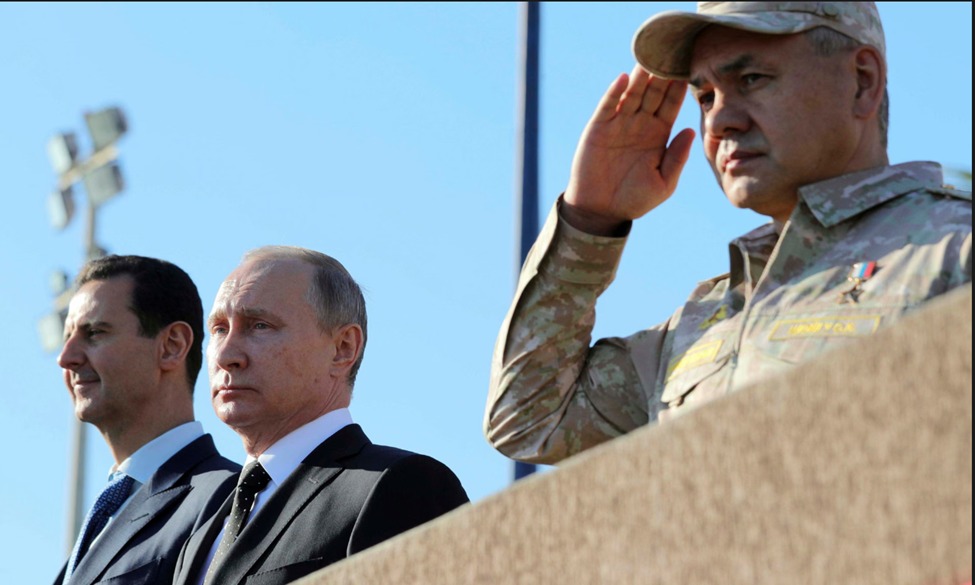
Source: https://www.theguardian.com/world/2017/dec/11/vladimir-putin-visit-to-syria-airbase-bashir-al-assad
Syrian president Bashar al-Assad(left), Russian president Vladimir Putin (centre) and defence minister Sergei Shoigu visit the Hmeymim airbase in Latakia province. Photograph: SPUTNIK/Reuters
“President Assad tells Russian leader Syrian people will never forget Russia’s help in driving Islamic State from country” [54]]
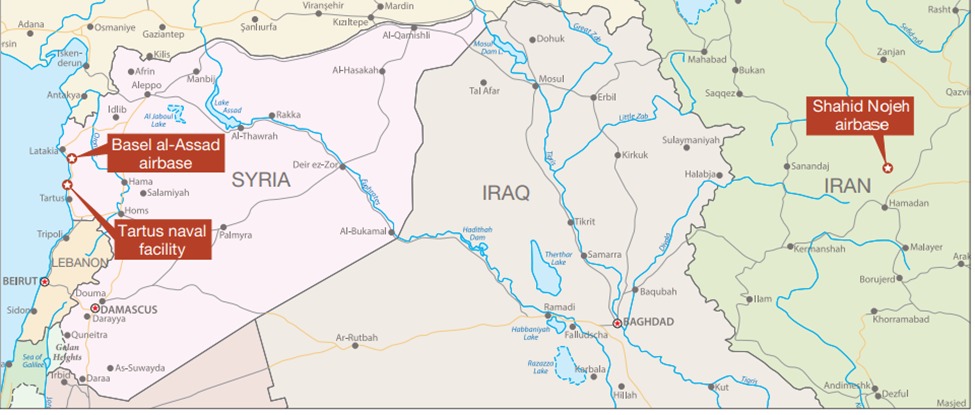
Source: SAMUEL CHARAP, ELINA TREYGER, EDWARD GEIS,Understanding Russia’s Intervention in Syria, Research Report, Rand Corporation, https://www.rand.org/content/dam/rand/pubs/research_reports/RR3100/RR3180/RAND_RR3180.pdf- The economic and political indicators
The control over key maritime and air power centers has strengthened Russia’s strategic position in the Middle East. At the same time, the financial and diplomatic support for the Syrian regime has enabled Moscow to transform the crisis into a versatile instrument of regional influence.
Second: The consequences of the Russian engagement after the Ukrainian war (2022-2025)
Redistribution of resources and efforts:
The war in Ukraine has imposed immense pressure on Russia’s military and economic capabilities. As a result, Russia has reduced its intensive military operations in Syria, while maintaining a limited and largely symbolic military presence. These changes suggest a tactical adjustment of priorities rather than a strategic withdrawal.- Alliances and Diplomacy
Diplomatic support for the Syrian regime continues in the UN and international forums. Moreover, despite being preoccupied with Ukraine, Syria was used as a strategic base for international negotiations.
Third: Comparing the involvement before and after the Ukrainian warThe indicator Before 2022 After 2022 Comments Russian forces in Syria Dense Relative decline Tactical adjustment, not complete withdrawal Air operations High Relatively low Redistributing resources to focus on Ukraine The political support Continuous Continued Structural interests continue without decline
Fourth: Analysing the hypotheses
H1: No Direct Trade-Off — Rejected
The findings indicate that Russia has not formally left Syria and has not entered into any explicit geopolitical agreement to link Syria to Ukraine. Therefore, the direct trade-off hypothesis is not supported.
H2: Decline in Military Commitment — Partially Supported
The data show measurable reductions in troop deployment and air operations after 2022. However, this reduction does not correspond to complete disintegration, but rather reflects partial adaptation under wartime constraints.
H3: Stability of Structural Interests — Supported
Evidence confirms that Russia maintains its strategic military bases, diplomatic engagements and regional influence in Syria. This supports the argument that core interests will remain intact.
H4: Implicit Trade-Off — Partially Supported
Although no formal agreement exists, the redistribution of resources suggests a limited implicit trade-off driven by strategic prioritization rather than explicit negotiation.
Sixth: The conclusion of the chapter
Russia has not formally left Syria after the war in Ukraine. Although its military engagement has decreased, this reduction reflects tactical adaptation rather than strategic withdrawal. Russia's structural and political interests in Syria remain largely intact. The reorganization of priorities after 2022 suggests an implicit trade-off at the level of resource allocation rather than an explicit agreement. Overall, the findings partially support most of the study's hypotheses and give a clear indication of Russia's strategic flexibility.
Chapter Nine
The conclusion and Recommendations
This chapter concludes the research by summarizing essential findings, providing clear scholarly results and proposing future recommendations that may be beneficial to academic studies and policy makers in understanding Russian politics in multi-regional contexts.
First: The main conclusions
The stability of Russia's structural interests in Syria
However, despite the Russian-Ukrainian war since 2022, Russia has continued to support the Syrian regime politically and militarily, maintaining its strategic bases in Hmeimim and Tartus. This indicates that long-term geopolitical interests were above any strategic pressure or temporary operations [55].
Reallocating the resources in response to the Ukrainian conflict
The war in Ukraine imposed tremendous pressure on Russia’s military and economic capabilities, resulting in a partial adjustment of its military focus in Syria.
The amendment was not a strategic withdrawal, but rather a tactical shift to manage risks and resources.
The absence of an explicit exchange between Syria and Ukraine
There have been no indications of an official agreement or direct swap announcement between the two arenas.
The theoretical illustration
The structural and offensive realism explains Moscow's behaviour as a response to anarchist threats and the search for hegemony and strategic stability [56].
Threat balance shows why the resources are redistributed without abandoning the structural interests.
The constructivism attempts to understand the continuity of the Russian behaviour in spite of the economic and military pressures, given that the identity and historical influence are crucial factors.
Second: The recommendations
For the academic researchers:- Expanding the scope of future studies to connect the multi-theater conflicts with strategic analysis of major policies.
- Employing both quantitative and qualitative comparative approaches to analyse the policies of great powers pre- and post-major conflicts, with the aim of elucidating alliance dynamics.
For the policymakers- Recognising that the tactical changes in a specific area do not mean abandoning the strategic interests.
- The necessity to monitor the distribution of the resources and military and political capabilities of major influential countries in order to understand the rearrangement of priorities.
For the international community:
The significance of distinguishing between tactical withdrawal and structural interests in analysing the policies of the major powers.
Enhancing the diplomatic instruments to counter the moves of the major powers in the conflict zones without always assuming explicit trade-offs.
Third: The research contribution- Bridging the gap in the academic research between the analysis of the Syrian arena and the Ukrainian war within a unified theoretical framework.
- To present an analytical model which can be applied to the multi-field studies in international relations.
- Integrating the military, economic, and diplomatic evidence with the realist and constructivist theories to explain the behaviour of the great powers.
Fourth: The final summary
Overall, the study finds that the war in Ukraine did not produce a formal Russian abandonment of Syria, nor does the available evidence substantiate the existence of an explicit geopolitical bargain linking the two theaters. Out of the shifts comes something different - a kind of quiet reshuffling. Russia lightened some tasks in Syria yet held on to key military positions and influence that give it weight across the region. So the piece suggests what looks like pulling back after 2022 is really more about adjusting moves under strain. That insight adds to debates on major power rivalry by revealing how nations juggle multiple demands, tweaking operations now without giving up ground later.
Author Contribution: All authors contributed equally to the main contributor to this paper. All authors read and approved the final paper.
Declaration of generative AI and AI-assisted technologies in the writing process
The authors hereby declare that no generative artificial intelligence or AI-assisted technologies were used at any stage during the preparation of this manuscript, including language editing, proofreading, or content development. The authors take full responsibility for the originality and integrity of the work presented in this publication.
Funding: “This research received no external funding”.
Conflicts of Interest: “The authors declare no conflict of interest.” -
References
References
1. Alagha, Malath. 2024. Political economy dynamics of Russia’s intervention in Syria. International Journal of Research in Business and Social Science, 13(1), 362–371. https://doi.org/10.20525/ijrbs.v13i1.3181
2. Saeed, I. (2025). Russia’s involvement in the Syrian Civil War: Motivation and consequences. Social Science Review Archives, 3(1), 1023–1033. https://doi.org/10.70670/sra.v3i1.401
3. Hinnebusch, R., & Imady, O. (2017). Syria’s uprising and the geopolitics of the Middle East. Third World Quarterly, 38(2), 223–238. DOIhttps://doi.org/10.4324/9781315143798
4. Lund, A. (2019). From Cold War to civil war: 75 years of Russian–Syrian relations. Swedish Institute of International Affairs. Link: https://www.ui.se/butiken/uis-publikationer/ui-paper/2019/from-cold-war-to-civil-war-75-years-of-russian-syrian-relations/
5. Phillips, C. (2016). The battle for Syria: International rivalry in the new Middle East. Yale University Press. Link: https://doi.org/10.2307/j.ctv1k03s4j
6. Trenin, D. (2016). Russia's Policy in the Middle East: Prospects for Consensus and Conflict with the United States. Carnegie Moscow Center. Link: https://carnegie.ru/2010/03/02/russia-s-policy-in-middle-east-prospects-for-consensus-and-conflict-with-united-states-pub-40324
7. Waltz, K. N. (2000). Structural realism after the Cold War. International Security, 25(1), 5–41. Link: https://www.jstor.org/stable/2626772?origin=JSTOR-pdf
8. Edinger, H. (2022). Offensive ideas: Structural realism, classical realism and Putin's war on Ukraine. International Affairs, 98(6), 1873–1893.DOI: https://doi.org/10.1093/ia/iiac217
9. Mearsheimer, J. J. (2001). The tragedy of great power politics. W. W. Norton & Company. Link: https://wwnorton.com/books/9780393349276
10. Mearsheimer, J. J. (2019). Bound to fail: The rise and fall of the liberal international order. International Security, 43(4), 7–50. DOI: https://doi.org/10.1162/isec_a_00342
11. Wendt, A. (1999). Social theory of international politics. Cambridge University Press. Link: https://www.guillaumenicaise.com/wp-content/uploads/2013/10/Wendt-Social-Theory-of-International-Politics.pdf
12. Walt, S. M. (1987). The origins of alliances. Cornell University Press. Link: https://web.stanford.edu/class/ips198/docs/Walt.pdf
13. Johnson, R. B., & Onwuegbuzie, A. J. (2004). Mixed methods research. Educational Researcher, 33(7), 14–26. DOI: https://doi.org/10.3102/0013189X033007014
14. Creswell, J. W. (2014). Research design: Qualitative, quantitative, and mixed methods approaches. Sage. Link: https://www.ucg.ac.me/skladiste/blog_609332/objava_105202/fajlovi/Creswell.pdf
15. Zhang, Y. (2016). China and liberal hierarchies. International Affairs, 92(4), 795–816. DOI: https://doi.org/10.1111/1468-2346.12652
16. Allison, R. (2013). Russia and Syria: Explaining alignment with a regime in crisis. International Affairs, 89(4), 795–823. DOI: https://doi.org/10.1111/1468-2346.12046
17. Charap, S., & Colton, T. (2017). Everyone loses: The Ukraine crisis. Routledge. Link: https://www.routledge.com/Everyone-Loses-The-Ukraine-Crisis-and-the-Ruinous-Contest-for-Post-Soviet-Eurasia/Charap-Colton/p/book/9781138633087
18. Galeotti, M. (2018). The modern Russian army. Osprey Publishing. Link: https://books.google.jo/books/about/The_Modern_Russian_Army_1992_2016.html?id=Mt7oDAAAQBAJ&redir_esc=y
19. Trenin, D. (2022). Russian Foreign Policy: Shifting Gears . outlook. Carnegie Endowment. https://carnegieendowment.org/posts/2021/11/russian-foreign-policy-shifting-gears
20. Göransson, M. (2023). A Strategy of Limited Actions: Russia’s Ground-based Forces in Syria. Oxford University Press. DOI: 10.1093/oso/9780192857422.003.0014
21. RUSI. (2020). Detailing Russian forces in Syria. Royal United Services Institute. Link: https://www.rusi.org/explore-our-research/publications/rusi-defence-systems/detailing-russian-forces-syria
22. Weissmann, Mikael, and Niklas Nilsson (eds),2023, Advanced Land Warfare: Tactics and Operations (Oxford, 2023; online edn, Oxford Academic, 20 Apr. 2023), https://doi.org/10.1093/oso/9780192857422.001.0001
23. IISS. (2016). The military balance 2016. International Institute for Strategic Studies. Link: https://www.iiss.org/publications/the-military-balance/the-military-balance-2016/
24. Michael Kofman, Anya Fink, Dmitry Gorenburg, Mary Chesnut, Jeffrey Edmonds, and Julian Waller, 2021, Russian Military Strategy: Core Tenets and Operational Concepts, CNA, Russia Studies Program, Strategy, Policy, Plans, and Programs Division, Link: https://www.cna.org/reports/2021/08/Russian-Military-Strategy-Core-Tenets-and-Operational-Concepts.pdf
25. IISS. (2018). The military balance 2018. International Institute for Strategic Studies. Link: https://www.iiss.org/publications/the-military-balance/the-military-balance-2018/
26. Michael Simpson, Adam R. Grissom, Christopher A. Mouton, John P. Godges, Russell Hanson. (2022). Road to Damascus, The Russian Air Campaign in Syria, 2015 to 2018 . CAST. Link: https://www.rand.org/pubs/research_reports/RRA1170-1.html
27. SAMUEL CHARAP, EDWARD GEIST, BRYAN FREDERICK, JOHN J. DRENNAN, NATHAN CHANDLER, JENNIFER KAVANAGH , 2021. Russia's Military Interventions Patterns, Drivers, and Signposts, RAND Corporation. https://www.rand.org/pubs/research_reports/RRA444-3.html
28. Samuel Charap, Dara Massicot, Miranda Priebe, Alyssa Demus, Clint Reach, Mark Stalczynski, Eugeniu Han, Lynn E. Davis, 2021, Russian Grand Strategy, Rhetoric and Reality, RAND Corporation, https://www.rand.org/pubs/research_reports/RR4238.html
29. Russia withdrawing troops from airport in northeast Syria, sources say, 2026, Reuters, https://www.reuters.com/world/russia-withdrawing-troops-airport-northeast-syria-sources-say-2026-01-26/
30. Phillips, C. (2022). The international system and the Syrian civil war. International Relations, 36(3), 358-381.DOI: https://doi.org/10.1177/00471178221097908
31. Kofman, M. (2020). Russia’s War in Syria: Assessing Russian Military Capabilities and Lessons Learned. Russian armed forces in Syria. FPRI. Link: https://www.fpri.org/article/2020/09/syria-and-the-russian-armed-forces-an-evaluation-of-moscows-military-strategy-and-operational-performance/?utm
32. Seth G. Jones, Danika Newlee, Edmund Xavier Loughran, Jason Gresh, Brian Katz, and Nicholas Harrington, 2020, Moscow’s War in Syria, CSIS Center for Strategic and International Studies, https://www.csis.org/analysis/moscows-war-syria
33. Hossain, I. (2015). The Russian military intervention in Syria. Background, Causes and Consequences, Al-Zaytouna Centre. Link: https://www.alzaytouna.net/en/files/attachments/ReportsZ/Refereed-Academic-Studies/Russian-Military_Intervention_Syria_Ishtiaq-Hossain_11-15.pdf
34. Jorge Trujillo R (2025) Russia's foreign and security policy in Syria: historical relations, Cold War paradigms, and contemporary geopolitics. Front. Polit. Sci. 7:1489285. doi: https://doi.org/10.3389/fpos.2025.1489285
35. Jabber, M. N. (2025). NATO from formation to expansion: A perspective on international relations. Al-Biruni Journal of Humanities and Social Sciences, 3(10). https://doi.org/10.64440/BIRUNI/BIR006
36. Lund, Aron, 2019. Russia in the Middle East, U Paper, https://www.ui.se/globalassets/ui.se-eng/publications/ui-publications/2019/ui-paper-no.-2-2019.pdf
37. Russia-Ukraine conflict: The uncertainty in the Middle East, Apr 2022,Midstone Centre for International Affairs (MCIA). https://midstonecentre.com/2022/04/russia-ukraine-conflict-the-uncertainty-in-middle-east/?utm
38. Mujeeb, A. ., Wakil, I. ., Liaqat, B. B. ., & Nawaz, A. . (2024). Syrian Civil War and Its Implication on Regional Politics. Research Journal for Societal Issues, 6(3), 314–322. https://doi.org/10.56976/rjsi.v6i3.286
39. Lo, B. (2015). Russia and the new world disorder. Brookings Institution. https://www.brookings.edu/books/russia-and-the-new-world-disorder/?utm
40. Marcin Kaczmarski, Mark N. Katz and Teija Tiilikainen, Dec 2018, THE SINO-RUSSIAN AND US-RUSSIAN RELATIONSHIPS CURRENT DEVELOPMENTS AND FUTURE TRENDS, FIIA reports, he Finnish Institute of International Affairs, https://cadmus.eui.eu/server/api/core/bitstreams/b3f303e9-904c-5f62-b74c-49f830433f03/content
41. DEREK AVERRE, LANCE DAVIES, Russia, humanitarian intervention and the Responsibility to Protect: the case of Syria, International Affairs, Volume 91, Issue 4, July 2015, Pages 813–834, https://doi.org/10.1111/1468-2346.12343
42. Allcock, Simon. Explaining Russia’s Intervention in Syria in September 2015,E-International Relations. https://www.e-ir.info/2016/02/28/explaining-russias-intervention-in-syria-in-september-2015/
43. Driedger, J. J., and Krotz, U. (2024) Preference Constellations in EU–Russian Crisis Bargaining over Syria and Ukraine. JCMS: Journal of Common Market Studies, 62: 487–507. https://doi.org/10.1111/jcms.13513
44. Barmin, Yuri, October 24, 2018, Russia and Israel: The Middle Eastern Vector of Relations, RUSSIAN INTERNATIONAL AFFAIRS COUNCIL. Link: https://russiancouncil.ru/en/activity/workingpapers/russia-and-israel-the-middle-eastern-vector-of-relations/?sphrase_id=164187618
45. Basbugoglu, T. (2025). Syria: Understanding Assad’s Unexpected Fall. Political Insight, 16(1), 22-25. ttps://doi.org/10.1177/20419058251332341
46. Kassis, Kelly. (2025). Russia’s enduring grip in Syria. RUSI The Royal United Services Institute for Defence and Security Studies, https://www.rusi.org/explore-our-research/publications/commentary/russias-enduring-grip-syria?utm
47. Shahid Jan Afridi, & Qaisar Ali. (2025). Trump New Approaches (Ceasefire Agreement) toward Russia-Ukraine Conflicts and Its Implications for Regional Security. Social Science Review Archives, 3(2), 214–229. https://doi.org/10.70670/sra.v3i2.607
48. Ågård, Carl. 2025. Peacemaking in Transition?: A comparative case study of Türkiye's and Saudi Arabia's mediation in Ukriane, (2025) FKVK02 20251, Link: http://lup.lub.lu.se/student-papers/record/9191220
49. Pollak, Nadav. Dec 7, 2015. Israeli-Russian Coordination in Syria: So Far So Good?. The Washington Institute for near east policy. https://www.washingtoninstitute.org/policy-analysis/israeli-russian-coordination-syria-so-far-so-good?utm
50. Grajewski, Nicole. Nov 2021. The Evolution of Russian and Iranian Cooperation in Syria. CSIS Center for Strategic and International Studies. https://www.csis.org/analysis/evolution-russian-and-iranian-cooperation-syria?utm
51. Lavrov, A. (2018). The Russian Air Campaign in Syria: A Preliminary Analysis. COP-2018-U-017903-Final, CNA, International Affairs Group Center for Strategic Studies, Link: https://www.cna.org/analyses/2018/06/russian-air-campaign-in-syria
52. Lavrov, A. (2018). The Russian Air Campaign in Syria: A Preliminary Analysis. COP-2018-U-017903-Final, CNA, International Affairs Group Center for Strategic Studies, Link: https://www.cna.org/analyses/2018/06/russian-air-campaign-in-syria
53. Seth G. Jones, Danika Newlee, Edmund Xavier Loughran, Jason Gresh, Brian Katz, and Nicholas Harrington. (2020). Moscow’s war in Syria. CSIS. Link: https://www.csis.org/analysis/moscows-war-syria
54.Vladimir Putin makes triumphant visit to Syria airbase,2017, the guardian, https://www.theguardian.com/world/2017/dec/11/vladimir-putin-visit-to-syria-airbase-bashir-al-assad
55. Atik Ali And Khalfallah Faouzi, The Russian Military Intervention in Ukraine: An Analysis through the Lens of International Law . (2025). Law and World, 11(34), 84-96. https://doi.org/10.36475/11.2.8
56. Mearsheimer, J. (2001). The tragedy of great power politics. Foreign Affairs review. Link: https://www.foreignaffairs.com/reviews/capsule-review/2001-11-01/tragedy-great-power-politics -
Article history
Received : Feb 02, 2026
Revised : Feb 04, 2026
Accepted : Mar 26, 2026
-
Authors Affiliations
Velyaminov A.A Toloraya 1, Lisovolik W. Gref 2
(1) PhD in Political Science , Department of International relations, MGIMO University, Moscow, Russia, 24 Vernadsky Prospect, Moscow 179994, Russia, tolorayaaa@mail.ru
(2) PhD Candidate, Department of Political Science, National Research University–Higher School of Economics, School of International Affairs, Moscow, Russia, lisovolikgref@hse.ru
* Corresponding Author: Velyaminov A.A Toloraya, tolorayaaa@mail.ru
-
Ethics declarations
Acknowledgment None Author Contribution All authors contributed equally to the main contributor to this paper. All authors read and approved the final paper. Conflicts of Interest “The authors declare no conflict of interest.” Funding “This research received no external funding” Ethical Considerations Ethical Considerations: Not applicable. This study did not require ethical approval because it does not include human or animal subjects and does not involve any personal or sensitive data. List of Abbrevation None Declaration of generative AI and AI-assisted technologies in the writing process The authors hereby declare that no generative artificial intelligence or AI-assisted technologies were used at any stage during the preparation of this manuscript, including language editing, proofreading, or content development. The authors take full responsibility for the originality and integrity of the work presented in this publication.
How to cite
License